
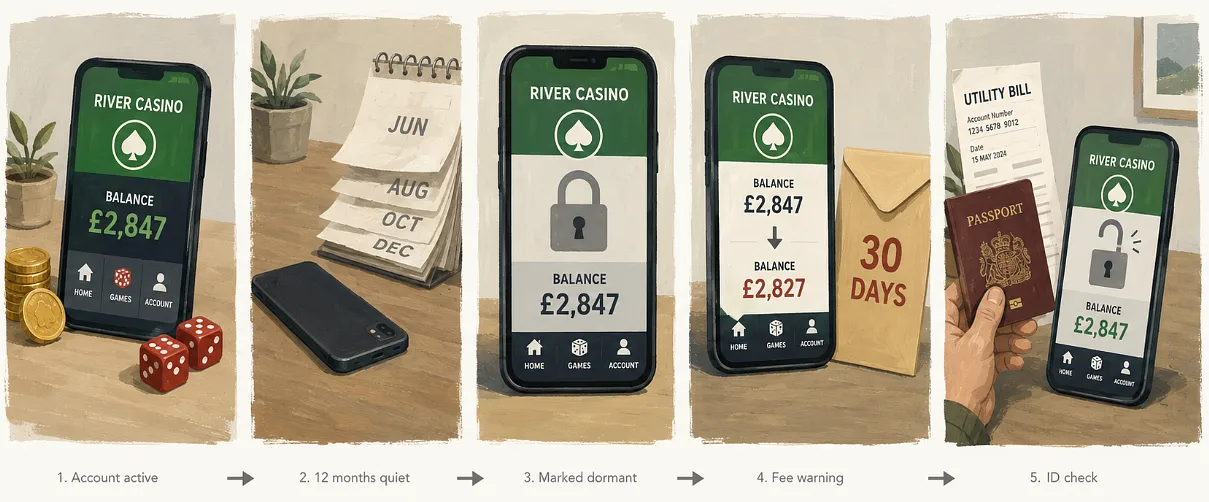
So you signed up to some online casino a couple of years back, probably one of those brands that target you with some welcome offer that gives you a little bonus for registering an account, played for a bit, got bored or busy or both, and now the details are either in an old email that you haven't used in years or tucked away in some old password manager. There is money in the account, or at least there was the last time you checked. You have no idea if it is still there or if someone quietly pinched it.
The good news is that nobody is allowed to just take it. The Gambling Commission has rules around this and they are actually more protective than most people expect. But the way in which different operators interpret those rules differs quite a lot more than you would think for something that is supposedly standardised across the industry.
Twelve Months of Nothing and Then the Clock Starts
UKGC's guidance makes it clear that an account is dormant if there has been no login, no deposit, no bet placed, no withdrawal or any other activity for twelve months, though operators can provide a more wide-ranging definition in their terms and conditions, so long as it is no less than twelve months.
What counts as "interaction" is where it gets a bit murky though because not every operator defines it the same way. For some operators, simply logging in and looking at your balance will reset the twelve month clock even if you do not touch a penny. On some, only financial transactions count, so you could log in every week and still technically be heading towards dormancy if you never deposit or place a bet. It should be in the terms and conditions, but nobody reads terms and conditions when they are signing up at half eleven at night because a mate told them about a free spins offer, which is how most of these accounts get set up in the first place.
Your Money Does Not Just Disappear But It Can Get Chipped Away
Once the twelve months are up, the operator must try to return your money to you before anything else can happen. This means they will attempt to return any remaining deposits made to the last deposit method used, whether that is a card, bank transfer, or e-wallet.
If that doesn't work, and sometimes it genuinely doesn't because cards expire and bank details change, then the operator is allowed to charge a maintenance fee. There are restrictions on what that maintenance fee can be, though, and they can't just slap whatever number they fancy on it.
The fee has to be reasonable and reflect the costs of administration, not just a made up penalty for not playing. They have to tell you at least thirty days before they take the first charge, which means that you can theoretically log in and withdraw before they take anything. And even if these fees eventually grind your account balance to zero, the operator cannot claim that your money is confiscated; it is still legally yours after the dormancy period, even if it is a trivial amount.
That distinction between "reduced through legitimate fees over time" and "we just kept it because you stopped showing up" is a line that the Gambling Commission does not let operators cross (at least not legally).
Getting Back In Usually Means Fresh Paperwork
If you have not used a casino account in two or three years, you will usually hit a verification wall if you try to login to play again. This is because, under Licence Condition 17 of the UKGC framework, operators are required to verify your identity, meaning if your documents have gone stale since you last played, they will want fresh ones.
You also need a passport or driving licence, proof of address dated within the last three months (like a utility or council tax bill), and if your old payment method expired, you need to add and verify a new one. This should all happen before they let you gamble again, not at the withdrawal stage, which is how it used to work with some operators until the Commission tightened up this area.
One thing that trips people up is how long it takes on a dormant account compared to a brand new signup. Customer support will hold returning dormant accounts with extra caution due to things like anti money laundering checks, and the fact that old accounts suddenly waking up after years of silence are familiar tell-tales of fraud. They may not think you are committing fraud, but they have more steps than the normal registration process to reduce potential fraud.
If You Self-Excluded Through GAMSTOP
Different situation entirely: if you signed up to GAMSTOP at any point during those years away, then every operator licensed by the UKGC is obliged to check against the scheme and block you for your chosen period. There is no way around this and no explanation to customer support will make them override it: the block is absolute until the period expires, and even then it does not lift by itself.
Once the exclusion time has passed, you have to actively contact GAMSTOP and request to be removed; they don't chase you up and say "right your time is done fancy a flutter." The block doesn't get lifted until you request it and it's designed that way, it's there to put a barrier in between you and gambling that you have to actively remove.
Any remaining funds in your account when you self-excluded should be refunded to your last payment method. How this happens will depend on the operator you used. While some will offer it within a couple of days, some will take longer and every so often the refund simply gets missed and you will have to chase it up yourself.
Where I Actually Checked the Detail on Dormancy Policies
I asked the guys at cazinouri.co.uk how much these dormancy rules vary from one operator to the next. A lot. They all have a floor due to the regulation that governs them but what they do on top of that varies wildly. The maintenance fee, the definition of what counts as activity, how aggressively they chase you with the thirty day warning, all of it. Some send a proper email with clear information about what is about to be deducted and why. Others send something that looks indistinguishable from a marketing email and gets ignored or filtered to spam. If they were legally required to send something, they technically met that obligation.
The risk of confusion comes from the divergence between what the regulation requires compared to what is actually applied to the player. The regulation itself is generally favourable to the player, but operators vary in how they apply it, so it's possible that two players in similar situations at different operators would have different outcomes.
Before You Try Logging Back In
First, some things worth sorting out to save you going back and forth with customer support for a week:
- Check the UKGC public register to ensure that the operator is still licensed, as operators do lose their licences and if yours did, it's a different conversation.
- Dig out any old emails from when you signed up, deposit confirmations, bonus terms, anything with dates and transaction references. Customer support works faster when you can point to specifics rather than saying "I think I had about forty quid in there."
- You should have your documents at hand before you log in, specifically a passport or driving licence, and a recent utility bill or bank statement. By uploading them at the beginning you will save yourself the endless back and forth of "please provide X" before you disappear for another three days.
- Each operator will have their own dormancy terms, which you can find on their website. Dormancy terms do change, and the terms that applied when you signed up may no longer be in effect.
- Keep your contact information up to date so that any future messages about your account will actually reach you. A thirty day fee warning sent to an email you abandoned in 2022 technically counts as notice even if you don't see it, but that's frustratingly legal.
To sum up, a dormant UK casino account does not mean the money has gone to the casino. The Gambling Commission will not allow this to happen, the fees operators can charge on dormant accounts are limited to genuine costs, and you can reclaim your funds even if your balance was reduced by maintenance charges along the way. Reentering is mostly a paperwork exercise not a crisis, and knowing what documents you need and what terms apply beforehand makes the difference between a smooth process and a drawn-out one.